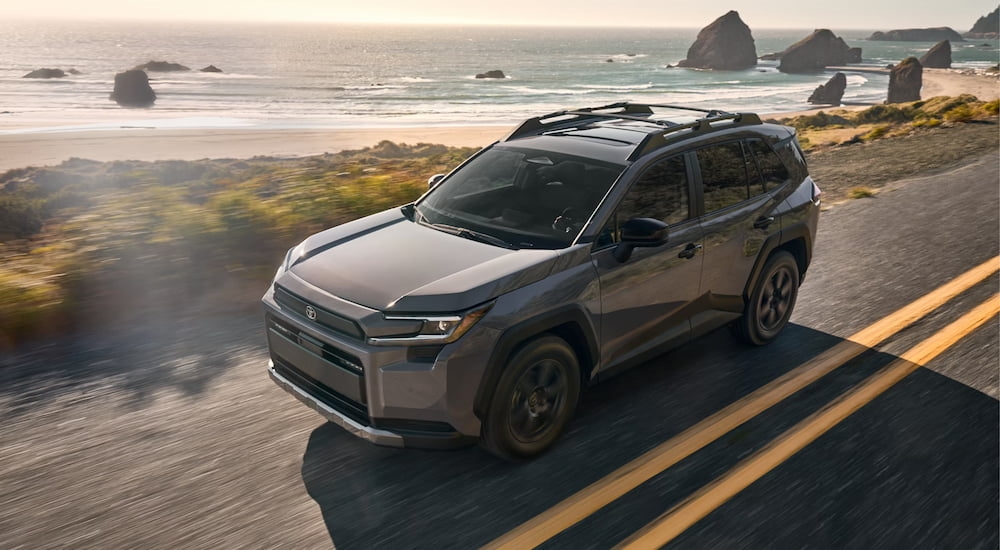
Compact SUVs dominate the automotive landscape, and for good reason: they expertly balance practicality and efficiency with comfort, value, and ingenuity more than nearly every other segment. Shopping for a Toyota RAV4 for sale near Glasgow means you’re one step closer to enjoying these perks, but not before considering the RAV4’s boldest rival–the 2026 Hyundai Tucson.
The RAV4 and Tucson bring strong credentials to the table, but 2026 proves to be another defining year for the iconic RAV4 that helped establish the crossover segment decades ago. Here are four ways the 2026 RAV4 edges ahead of the 2026 Tucson, treating drivers like you to more overall value, ingenuity, and the proven reliability you deserve when you climb behind the wheel.
#1 Performance: A Powertrain That Pushes Ahead
One of the RAV4’s most significant advantages in 2026 is its strong focus on reliable and engaging performance. Toyota has shifted the entire RAV4 lineup to a standard hybrid powertrain, meaning every RAV4 trim delivers superior fuel economy and on-demand power compared to traditional internal combustion engines. In contrast, Hyundai requires drivers to pay more to replace the Tucson’s standard gas powertrain with a hybrid or plug-in hybrid.
The Glasgow Impact
How does this affect you? The 2026 RAV4 delivers more horsepower and better efficiency than its Hyundai rival, resulting in a better driving experience and more savings at the pump.
The 2026 Tucson is powered by a 2.5L inline-four that produces up to 187 hp. The 2.6L turbocharged inline-four HEV produces up to 231 hp, and the PHEV version with a 13.8 kWh battery produces up to 268 hp. The output is impressive until you realize the 2026 RAV4 offers significantly more excitement behind the wheel.
The 2026 RAV4’s standard 2.5L inline-four hybrid powertrain produces between 226 hp and 236 hp, depending on configuration, with Toyota upping that output to 320 hp by adding a 22.7 kWh battery to the PHEV. Toyota puts more power at your feet, making the 2026 RAV4 more agile, engaging, and responsive than the Tucson.
For drivers navigating highways, winding backroads, and commutes plagued with heavy traffic, the RAV4’s added power makes a notable difference. Stronger acceleration and heightened responsiveness mean easier highway merging, smoother passing, and a more confident feel. Best of all, that performance comes without the fuel consumption typically associated with more powerful engines.
#2 Efficiency and Capability: No-Compromise Savings
Thanks to its hybrid-focused lineup, the 2026 RAV4 delivers excellent fuel economy and surprising capability that holds up in real-world conditions. Compared to the 2026 Tucson, the 2026 RAV4 is expertly engineered to save you more money at the pump and does double duty as an impressive towing partner.
The Glasgow Impact
Toyota’s engineering expertise shines when you compare fuel economies and towing capacities between the 2026 RAV4 and 2026 Tucson. Hyundai attempts to match Toyota’s efforts, but falls short. The Tucson HEV averages an EPA-estimated 38 MPG combined; the Tucson PHEV is even less efficient, with a 32-mile all-electric range with all-wheel drive.
Glasgow drivers looking to save will have no trouble with the 2026 RAV4 HEV or RAV4 PHEV. The compact hybrid delivers significantly more horsepower than the 2026 Tucson, but it’s also more efficient and averages an EPA-estimated 47 MPG in the city and 40 MPG on the highway. The news is even better for the RAV4 PHEV, which has a Toyota-estimated 50-mile all-electric range, leaving the Tucson behind.
The 2026 RAV4’s lead over the 2026 Tucson forges ahead in terms of real-world usability. As a compact SUV, the Tucson offers a maximum towing capacity of 2,750 lbs with its standard gas engine. The 2026 RAV4’s work ethic is undeniably better, with its hybrid and plug-in hybrid engines capable of towing up to 3,500 lbs.
Fewer stops for fuel mean more money stays in your wallet, while the RAV4’s higher towing capacity extends its versatility. It can tow a small trailer, boat, or recreational equipment with ease, proving that its efficiency and capability work together, without compromise.
#3 Cabin Experience: Comfortable, Intuitive, & Built to Last
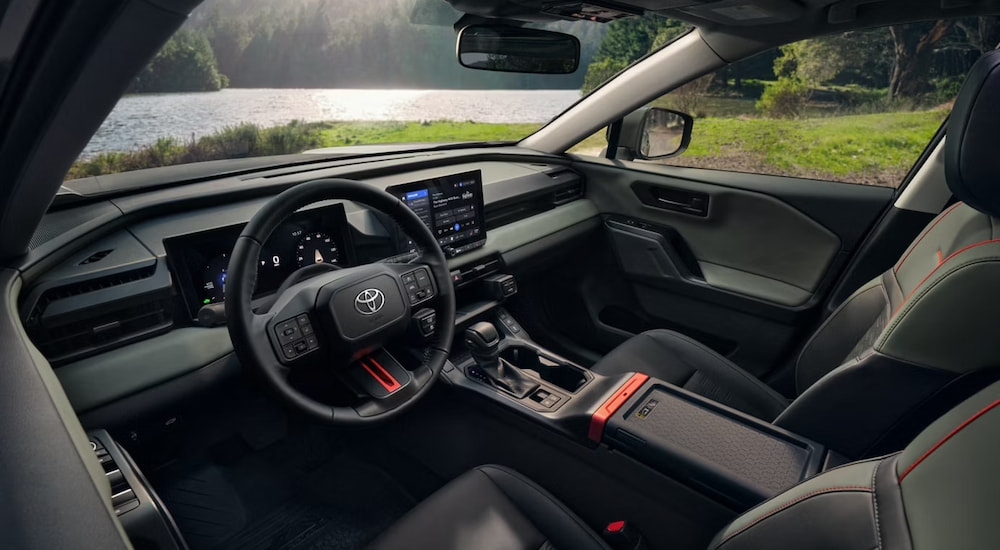
The 2026 RAV4’s cabin emphasizes comfort, visibility, and intuitive design over unnecessary flash and inconsequential details. With clean lines, heightened visibility, practical features, and an impressive digital landscape, the 2026 RAV4 feels more driver-oriented and thoughtfully designed than its rival.
The Glasgow Impact
It’s not that the 2026 Tucson is unimpressive, but it leans heavily into a tech-focused aesthetic that ignores essential needs, such as comfort, intuitiveness, and convenience. For example, the 2026 Tucson has a 12.3-inch center touchscreen with wireless Apple CarPlay and Android Auto; however, the 4.2-inch gauge cluster feels like an afterthought.
The 2026 RAV4 has a more intuitive design, from its easy-to-reach controls to the 10.5-inch or 12.9-inch center touchscreen that pairs perfectly with the 12.3-inch gauge cluster. The larger driver display provides clear performance insights, navigational cues, driver-assist alerts, and maintenance reminders, all of which are crucial to your experience behind the wheel.
Beyond its driver-focused digital landscape, the 2026 RAV4 is designed to adapt and complement your life. Toyota ensures as much with the RAV4’s versatile interior design and many available features, ranging from dual-zone climate control and a stunning panoramic glass roof to power-adjustable SofTex-trimmed heated and ventilated front seats and heated rear seats.
These details enhance the RAV4’s functionality and the practicality that’s defined the iconic crossover for decades; alternatively, Hyundai treats essentials like dual-zone automatic climate control as a luxury that will cost you far more than the Tucson’s sticker price.
#4 Overall Value: Reputation, Reliability, and Resale
Would you trust someone with more or less experience? In the automotive industry, reputations and legacies build brand loyalty that is impossible to ignore. Newer brands, like Hyundai, face steep competition from well-established automakers like Toyota, whose reputation for reliability is far more than a marketing strategy; it’s a critical advantage that influences resale values and long-term cost of ownership.
The Glasgow Impact
The 2026 Tucson is in its fourth generation, while the 2026 RAV4 debuts in its sixth generation after helping introduce the crossover segment in the 1990s. Although Hyundai’s reputation has improved dramatically in recent years, it’s impossible to ignore the RAV4’s stellar reputation and Toyota’s historic track record.
Glasgow drivers reap the benefits, with the 2026 RAV4 promising a higher resale value, lower long-term ownership costs, and the peace of mind that’s ingrained in Toyota’s reputation. In many cases, RAV4 owners pay less over the life of the vehicle, even if the RAV4’s initial cost is slightly higher.
For 2026, the RAV4’s starting price of $31,900[a] offers considerably more value—both in terms of features and overall quality—than the $29,200[a] Tucson.
Final Verdict: A Toyota Win for Glasgow Drivers
The 2026 Hyundai Tucson is a capable and attractive compact SUV that’s earned plenty of attention for its sleek styling and tech-savvy interior. However, many drivers want more substance, viewing their options through the lens of performance, efficiency, everyday usability, and long-term value. The 2026 RAV4 clearly comes out ahead.
With standard hybrid power, superior efficiency, stronger towing capability, intuitive technologies, and thoughtful design details, the 2026 RAV4 delivers the confidence and versatility you deserve. Toyota’s reputation for building long-lasting vehicles promises a significant return on your investment, adding confidence and peace of mind on the new lot because you know the value of what you’re getting.
The choice is clear: the 2026 RAV4 isn’t just competitive. It’s a compact SUV built to go further, last longer, and deliver more tangible value every mile.